Describing AI in Two Words
Artificial intelligence and the spectrum of human perceptions

A few days ago I asked Substack readers to describe AI in just two words without using "artificial intelligence" (of course). To be honest, I was not sure what to expect. I received a wide and interesting range of thoughts, fears, hopes, and dreams. From Job Losses to Utopia Possibility, the answers painted a spectrum of perceptions, each with real-world implications for how we interact with technology. These views can shape not just our understanding of AI but also its adoption, our daily lives, and the future we’re building. Let’s explore this mosaic, from the darkest fears to the brightest visions, and consider what it means for us all.
Disclaimer
It’s important to note that not everyone who describes AI as Imminent Threat, Mindless Automation, or Lacking Originality necessarily feels fear, anxiety, or skepticism. These two-word descriptions may be inspired by intellectual critique, personal experience, or even artistic framing. However, when we examine their broader implications, and more specifically how they influence behavior, adoption, or trust, we begin to see consistent categorical and emotional patterns emerge. The categories and emotions outlined in this article are not labels for individuals, but reflections of the practical impact these perceptions have on our collective relationship with AI.
The AI Perceptions Hierarchy
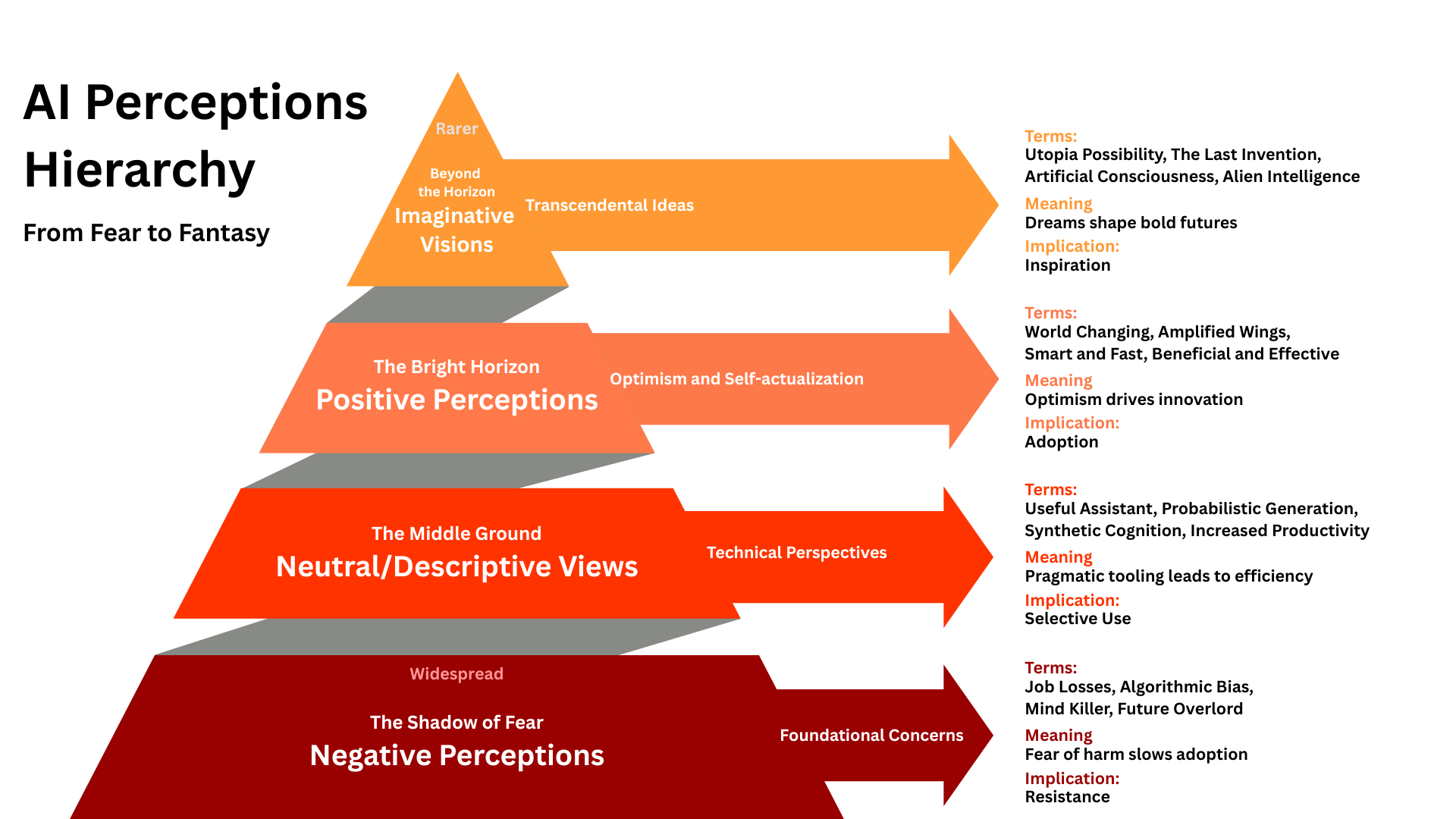
While compiling the different two-word descriptions of AI, I identified four major categories:
Negative Perceptions, which represent foundational concerns: The Shadow of Fear;
Neutral and Descriptive Views, which are more technical, pragmatic views of AI: The Middle Ground;
Positive Perceptions, which are fueled by optimism: The Bright Horizon;
Imaginative Visions, which represent transcendental ideas: Beyond the Horizon.
With these categories identified and inspired by Maslow’s hierarchy of needs, I propose the AI Perceptions Hierarchy, which maps how people view AI: from primal fears of Job Losses to transcendent dreams of Utopia Possibility. At its base, negative perceptions like Algorithmic Bias fuel resistance, slowing tech adoption. Neutral and descriptive views, such as Useful Assistant, drive selective use in daily tasks. Positive outlooks, like World Changing, accelerate innovation, while imaginative visions of Artificial Consciousness inspire bold futures. Each tier shapes how we integrate AI, from cautious skepticism to visionary ambition, revealing the human lens through which we navigate technology’s threats and rewards.
Honoring the Participants
I am grateful to those in the Substack community who contributed and to honor their participation, I have referenced their exact words into this narrative. For a full list of responses, see the comments section of my original note.
Highlights of AI Perceptions
Negative Perceptions
We started at The Shadow of Fear. Not surprisingly, some see AI as an imminent threat. Job Losses captures the anxiety that automation could displace workers, from factory floors to creative industries. This fear can slow technology adoption as employees and unions push back, wary of economic upheaval. Similarly, Algorithmic Bias highlights distrust in AI’s fairness, pointing to real-world cases where biased systems have perpetuated inequality in hiring or criminal justice. When people view AI as a Mind Killer or Misused Tool, they hesitate to embrace it, fearing it could erode critical thinking or be weaponized unethically. Procrustean Bed implies AI technologies forcing complex human realities into rigid, predefined molds. Game Over and Future Overlord evoke dystopian visions of AI surpassing human control, a narrative that fuels public skepticism and calls for regulation. These negative perceptions create a tangible impact: slower integration in workplaces, heightened scrutiny of AI developers, and a public less willing to trust smart systems in daily life.
Neutral and Descriptive Views
We then move to The Middle Ground, where others take a more measured stance, seeing AI as a tool or process. Useful Assistant and Smart Assistance reflect a pragmatic view of AI as a productivity booster, like a virtual colleague handling mundane tasks. Increased Productivity and Automation and Efficiency echo this, suggesting AI’s role in streamlining workflows, from scheduling to data analysis. Yet, neutrality isn’t always rosy. Copy Cat and Encyclopedic Regurgitator hint at AI’s limitations, portraying it as a mimic rather than a creator, which can temper enthusiasm for its use in creative fields. Underestimated, Misunderstood suggests a knowledge gap, where people’s uncertainty about AI’s capabilities leads to cautious or uneven adoption. Descriptive terms like Computerized Reasoning, Probabilistic Generation, and Synthetic Cognition offer technical accuracy, appealing to those who see AI as a complex but understandable system. These views drive practical outcomes: businesses adopt AI for efficiency but may limit its scope to routine tasks, while individuals use tools like chatbots but question their originality.
Positive Perceptions
Next is The Bright Horizon. On the optimistic end, AI is a catalyst for progress. Beneficial and Effective and Clarity and Productivity highlight its ability to solve problems, from medical diagnostics to personal organization. World Changing and The Future cast AI as a transformative force, inspiring innovators to integrate it into education, healthcare, and beyond. My Level-Up and Amplified Wings convey a personal empowerment, where AI enhances skills and creativity, like a digital mentor. Smart and Fast celebrates its speed and intelligence, driving enthusiasm for AI-powered devices in homes and offices. These positive views accelerate adoption such as consumers embrace smart assistants, companies invest in AI-driven solutions, and educators explore AI to personalize learning. The optimism fuels a cycle of innovation, but it also risks overlooking AI’s flaws if enthusiasm outpaces caution.
Imaginative Visions
Finally, we have Beyond the Horizon. The most imaginative responses transcend practicality, dreaming of AI’s potential. Utopia Possibility envisions a world of abundance, where AI solves global challenges like poverty or climate change. The Last Invention suggests AI could be humanity’s ultimate creation, sparking philosophical debates about our role in a post-AI world. Artificial Consciousness and Alien Intelligence ponder AI as a new form of sentience, raising ethical questions that could shape future policies. Becoming Real and Something New evoke a sense of AI evolving into a partner or entity, blurring lines between technology and life. Ancient Inspiration and A Mirror reflect on AI as a reflection of human ingenuity or a revival of age-old aspirations to create. These visions inspire bold experimentation but can also polarize where some rush to build such futures, while others fear the unknown, slowing adoption of frontier technologies.
The AI Emotion Wheel
As I continued analyzing the intriguing variety of two-word responses, I noticed something beyond categories or hierarchies. Embedded in each phrase was a feeling, a subtle emotional tone that revealed not just what people think about AI, but how they feel about it. Some saw it with awe, others with suspicion. Some embraced it with hope, others braced for harm.
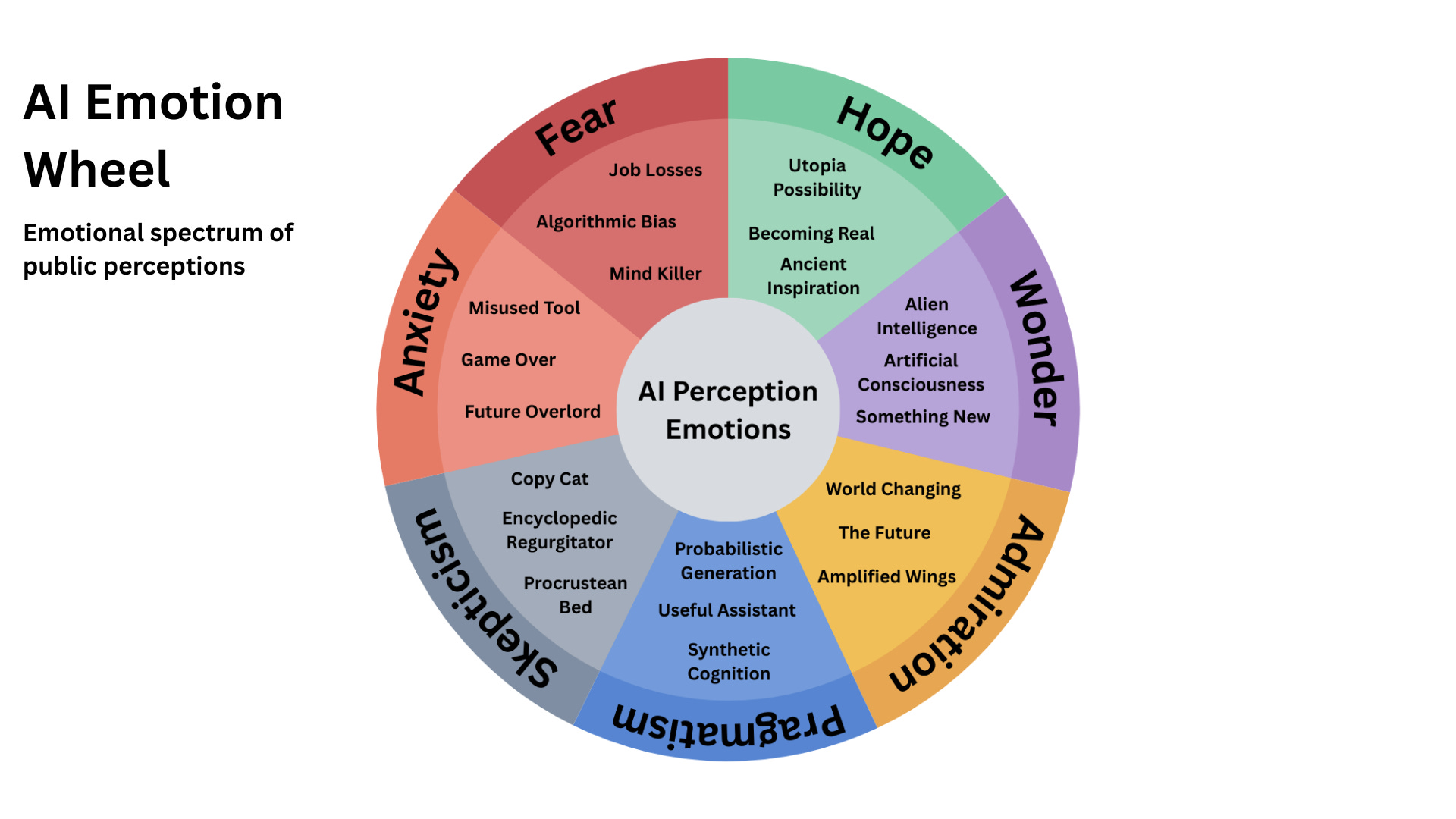
Inspired by emotional frameworks like Plutchik’s Wheel of Emotions, I propose the AI Emotion Wheel, which maps the emotional spectrum of public perceptions. Each segment represents a distinct emotional response: Fear, Anxiety, Skepticism, Pragmatism, Admiration, Wonder, and Hope, with representative phrases drawn directly from the community’s words.
This wheel captures the wide range of sentiments shaping our collective response to artificial intelligence. It is a reminder that emotions can fuel or stall adoption, color expectations, and influence everything from policy to personal use. Whether we see AI as a Useful Assistant or a Future Overlord, our emotional framing matters as it guides how we talk about, build with, and live alongside intelligent machines.
A Call to Reflect
AI is not just one thing. Trough real world examples, and based on our small experiment, we can see that it can be Job Losses and Utopia Possibility, Copy Cat and perhaps even The Last Invention. Each view carries weight, influencing how we build, use, and live with technology. As we navigate this landscape, let’s ask ourselves: How do our perceptions of AI shape our choices? And how can we balance fear, pragmatism, optimism, and imagination to create a future that serves us all? If you did not participate yet, you still can share your two words in the comments below. I’m eager to keep this conversation alive.
Good Assistant
Loved this. Feels like a shortcut to something deep, two words with room for all our contradictions. Mine today: quiet mirror. But tomorrow it might be feral assistant or synthetic ache. Depends what it reflects back.
Thanks for holding space for all of it.